10% VAT will be added to all procedures.
Contouring Filler
The Face Is Perceived Through Structure,
Not Volume
When we look at a face, we perceive its structure before its volume. The boundary between the jaw and neck, the position of the cheekbones, and the projection of the midface can make the same face appear entirely different in proportion. The impression of a face is shaped less by volume itself and more by which structures create its center, where light falls, and how the contours connect. This is why modern contouring filler is gradually moving beyond simply filling hollow areas. Rather than adding volume, it focuses on refining the balance between bone structure and soft tissue to create clearer facial definition. Ultimately, we are more sensitive to how a face is structured and where its central axis lies than to how much volume has been added.
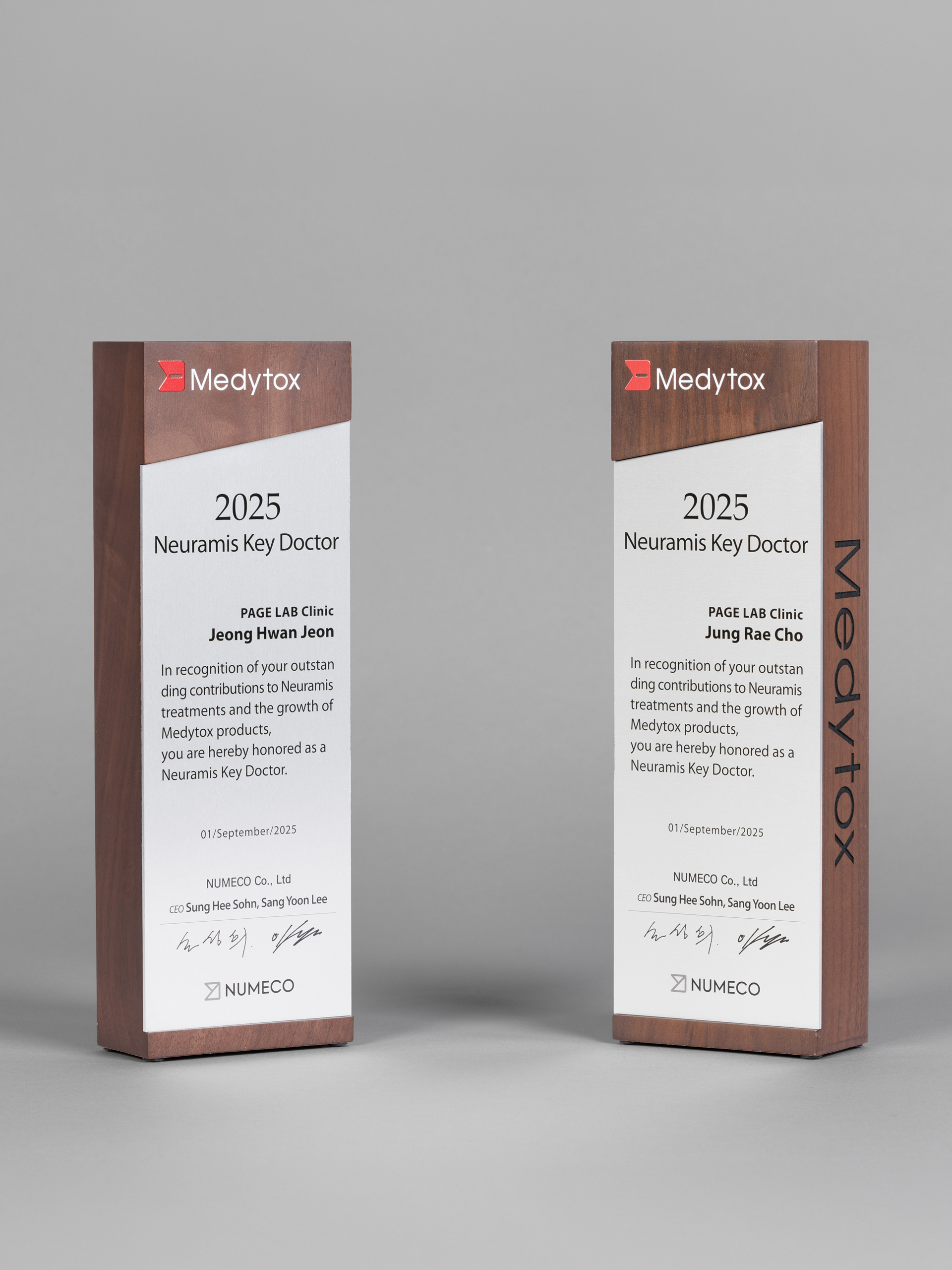
Designed by a Restylane Master and Neuramis & Amalian Key Doctor
These titles reflect a deep understanding of filler materials. With expertise as a Galderma Restylane Master Doctor and a Medytox Neuramis and Amalian Key Doctor, Page Lab precisely adjusts each material according to its unique properties. When a thorough understanding of the material meets years of clinical experience and a refined sense of design, the result goes beyond volume—allowing the most harmonious facial lines to emerge.
For years, filler was primarily seen as a way to fill hollow areas and add volume. Over time, however, excessive volume has repeatedly been shown to blur facial boundaries, creating a heavier and less defined appearance. Facial dimension is often determined less by volume itself than by the balance between underlying structures. The position of the bone, support from the deep fat compartments, and the direction of retaining ligaments can make a face appear more defined—or, conversely, flatter. This is why modern contouring filler is evolving toward correcting imbalances within the face’s existing structure rather than dramatically changing its size or shape.
Does Filler Still Have to Be About Filling?
The impression of a face is shaped by how its structures connect—from the central axis of the nose and the forehead-to-bridge transition to the relationship between the cheeks, under-eyes, chin, and neckline. Contouring filler is therefore less about adding volume to individual areas and more about refining each feature to create balance across the face. Nose filler defines the central axis, while nasolabial angle filler adds dimension to the profile. The forehead and temples connect the upper facial flow, while the cheeks shape where light naturally falls. The chin refines lower-face proportions, while the lips influence the overall impression through proportion and structure rather than size. Around the eyes, filler can soften a tired appearance and create more natural transitions. Neck-line filler also helps refine the connection between the jawline and neck. Ultimately, contouring filler is not about dramatically changing one feature, but finding where every structure connects most naturally.
Designing the Boundaries of Light and Shadow
Even when treating the same area, filler cannot be approached the same way for every face. At Page Lab, we first analyze the facial axis and contour flow rather than simply where volume is lacking. We consider the face from the front, 45-degree angle, and profile, including how structure changes with expression and where light and shadow meet. For the chin, we consider projection, vertical length, and lower-face proportions. For the under-eyes, the connection with the anterior cheek and shadow flow is key. For the forehead, curvature toward the nasal bridge matters more than volume alone, while the lips require balance in shape, proportion, and projection. This is why Page Lab sees filler not simply as adding volume, but as a precise reading of facial structure and balance.
Reading Structure. Designing Balance.
The face responds to balance more than change. Contouring filler is less about adding something new and more about revealing the existing structure. At Page Lab, we look first at structure and connection, not volume. The direction in which the face looks most natural—that is how Page Lab designs contouring filler.
How Page Lab Reads the Face
On the Record
Contouring Filler at Page Lab
A record of how Page Lab's physicians have studied and shared Contouring Filler — lectures, training and news, gathered in one place.
Balance That Enhances Dimension
Defining the Facial Center
The eye naturally follows the center of the face. When the transition between the forehead and nose is weak or the central axis lacks definition, the face can appear flatter. Nose and nasolabial angle filler help refine this central flow, creating clearer definition from both the front and profile.
Recommended Combinations
Restoring a Tired-Looking Midface
The anterior cheeks and under-eye area play an important role in facial dimension and vitality. When volume decreases, the face can appear more tired than its actual age. Filler in the front cheeks, lateral cheeks, and under-eyes helps support the midface structure and restore where light naturally falls, creating a more refreshed appearance.
Recommended Combinations
Refining Lower-Face Proportions
Facial balance is often completed by the lower face. The length and projection of the chin, along with the transition between the jawline and neck, can significantly change how facial proportions are perceived. Chin filler helps refine lower-face proportions and contour flow.
Recommended Combinations
Adding Subtle Points of Definition
The face responds more to proportion than size. The lips and aegyo-sal are subtle features that can shape the overall impression. Lip filler refines proportion and volume, while aegyo-sal filler creates a natural focal point around the eyes.
Recommended Combination